Embroidery Digitizing
How Much Does Embroidery Digitizing Cost in the USA? (2026 Pricing Guide)
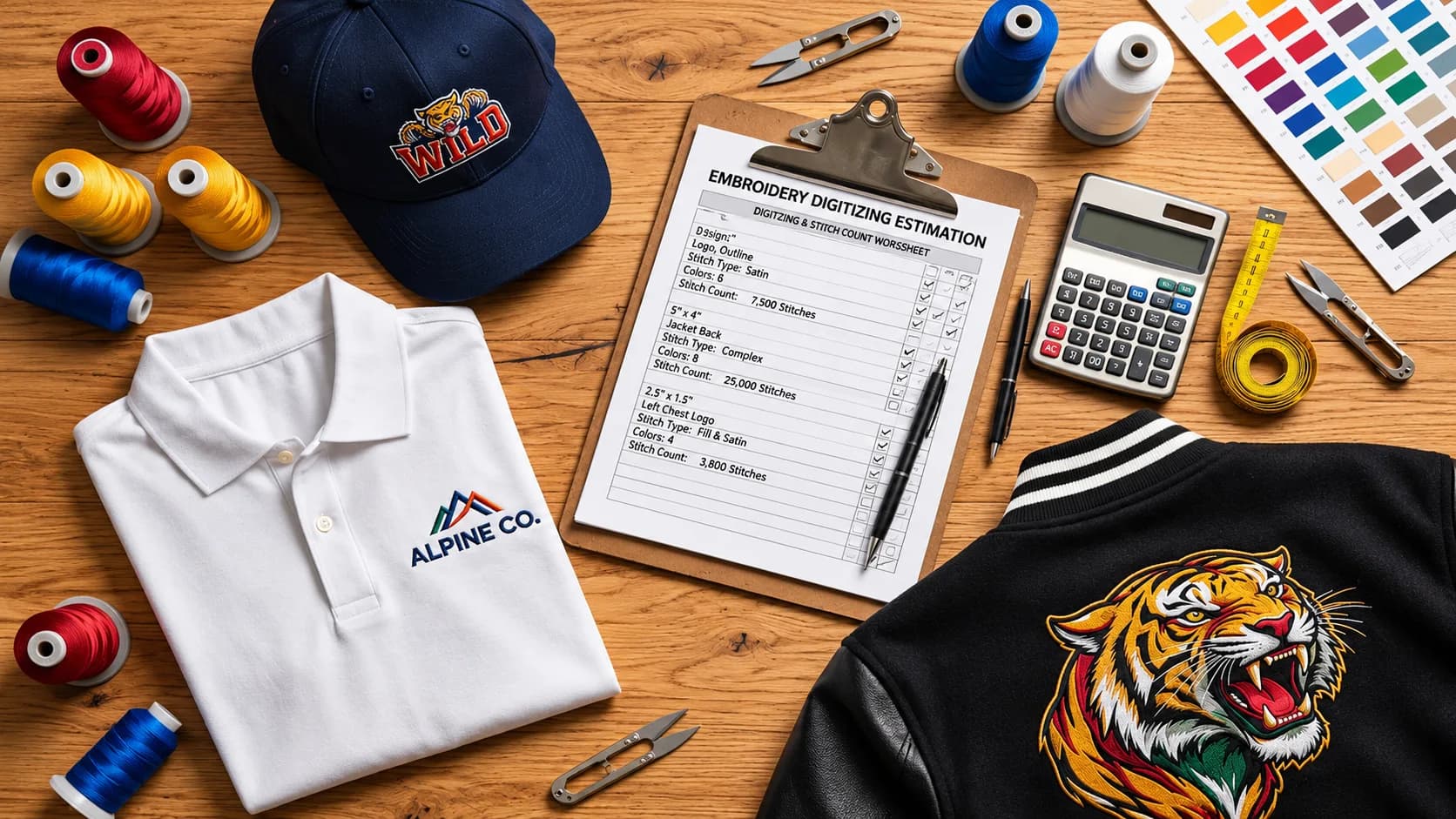
If you run an embroidery shop, manage a clothing brand, or want your business logo embroidered on uniforms, one of your first questions is probably: How much does embroidery digitizing cost?
The answer depends on the artwork, its finished size, stitching requirements, and the digitizing company you choose.
In 2026, publicly advertised prices from embroidery digitizing providers serving the US market range from around $10–$20 for many small logo designs to $45–$60 or more for certain large or detailed designs. These are examples from individual providers, not an official industry average.
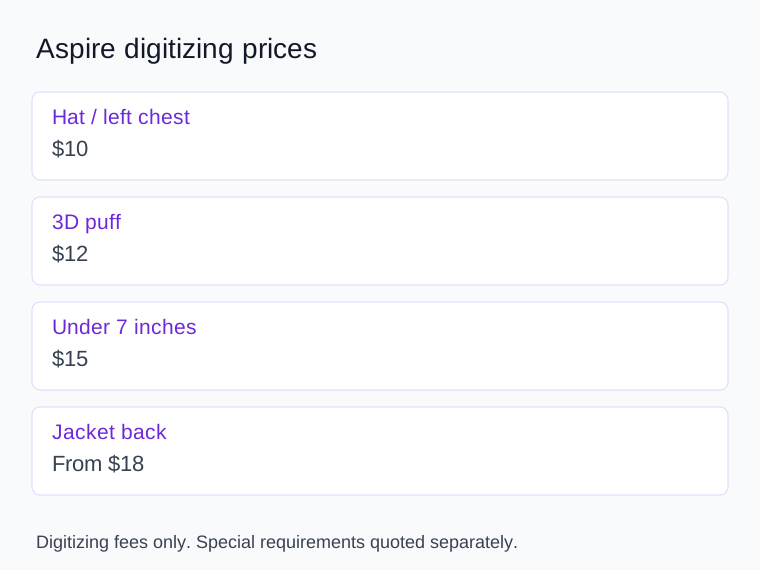
At Aspire Digitizing, our standard digitizing prices include $10 for hat or left-chest logos, $12 for 3D puff designs, $15 for designs under 7 inches, and jacket-back digitizing starting at $18.
But the price of creating an embroidery file is only one part of the overall cost. You'll also need to understand machine setup, stitching charges, design changes, and how the quality of a digitized file affects production.
This guide breaks down digitizing costs in the USA, explains the most common pricing models, and helps you make an informed decision before ordering.
How Much Does Embroidery Digitizing Cost in 2026?
Embroidery digitizing is commonly charged as a design-preparation service. A digitizer converts artwork into a file containing machine-ready stitch instructions.
Many providers charge a fixed fee per design or size category, while others calculate prices according to stitch count or project complexity.
The following table shows examples of publicly advertised pricing from different digitizing providers.
| Provider | Small or Left-Chest Design | 3D Puff | Jacket-Back Design |
|---|---|---|---|
| Aspire Digitizing | $10 for hat/left chest | $12 | Starting at $18 |
| PRO Digitizing | From $15 | From $25 | From $60 |
| Digitizing Delight | $20 for designs up to 4 inches | $10 add-on to a qualifying design | $60 for 8–12-inch designs |
| Hat Digitizing | From $15 for left chest or flat hat | From $20 | From $45 |
These prices represent the providers' advertised offerings, which may differ in included services, design-size limits, turnaround, revisions, and machine file formats. Rates may change after publication.
Important: These figures are not directly comparable quotations for the same artwork. A $20 package that includes several deliverables may not be equivalent to a $10 basic digitizing service.
For an accurate estimate, submit your artwork with the intended embroidery size and placement.
Quick Pricing Summary
Here is Aspire Digitizing's current standard digitizing price schedule:
| Digitizing Service | Price |
|---|---|
| Hat or left-chest logo | $10 |
| 3D puff digitizing | $12 |
| Designs under 7 inches | $15 |
| Jacket-back designs | Starting at $18 |
These prices are for digitizing services—not embroidered garments, blank apparel, or machine stitching.
Complex designs or special requirements may need an individual quotation.
What Is Embroidery Digitizing, and Why Does It Cost Money?
Embroidery digitizing is the process of converting an image, logo, or graphic into stitch instructions that a compatible embroidery machine can follow.
A PNG, JPG, PDF, or vector file may show exactly how your design should look, but it does not automatically provide all the sewing instructions needed for quality machine embroidery.
A digitizer must interpret the artwork and decide how to construct the design using different stitch types, directions, sequences, and settings.
Turning Artwork Into Machine-Ready Stitches
Consider a company logo with bold lettering and a small decorative symbol.
A digitizer may need to:
- Evaluate which details can be reproduced at the requested size.
- Select running, satin, and fill stitches where appropriate.
- Determine stitch directions and sewing sequence.
- Apply suitable underlay and pull compensation.
- Account for the intended fabric and embroidery placement.
- Prepare a machine-compatible output file.
- Review the resulting stitch structure before delivery.
These decisions affect how the embroidery behaves during production.
A design that looks attractive on a computer screen may still stitch poorly if its density, sequencing, or small details are unsuitable.
For a complete explanation of the process, read our guide: What Is Embroidery Digitizing? A Complete Beginner's Guide.
What Does a Digitizing Fee Cover?
A digitizing fee typically pays for the skilled work needed to turn an artwork file into an embroidery design.
The specific deliverables depend on the provider's service terms.
Depending on the quotation, a service may include the initial digitizing work, one or more machine file formats, a stitch preview, or certain corrections.
However, do not assume every company includes unlimited revisions, every machine format, or editable source files without checking first.
Is Embroidery Digitizing a One-Time Cost?
Often, yes.
Once a logo has been properly digitized for a specific size, placement, fabric, and production workflow, the same file may be reused for later orders.
For example, a business could digitize a left-chest logo once and use that approved file to embroider multiple batches of polo shirts.
However, changes to size, fabric, placement, or stitch requirements may require editing or a separate digitizing version.
A cap design and a flat left-chest version of the same logo may not be interchangeable.
How Do Embroidery Digitizing Companies Calculate Prices?
There is no single pricing method used by every embroidery digitizing company.
The most common approaches include flat-rate pricing, per-stitch pricing, and custom quotations.
Flat-Rate Embroidery Digitizing
Flat-rate pricing assigns a fixed price to a type or category of design.
For example, a provider might charge one price for a left-chest logo and another for a jacket-back design.
This system is convenient for customers because it makes budgeting easier.
Advantages:
- Straightforward quotations
- Easier cost planning for repeat orders
- Less uncertainty about final stitch count
- Simple comparison between design categories
However, complex artwork may fall outside a standard tier and require a custom quote.
Per-1,000-Stitch Pricing
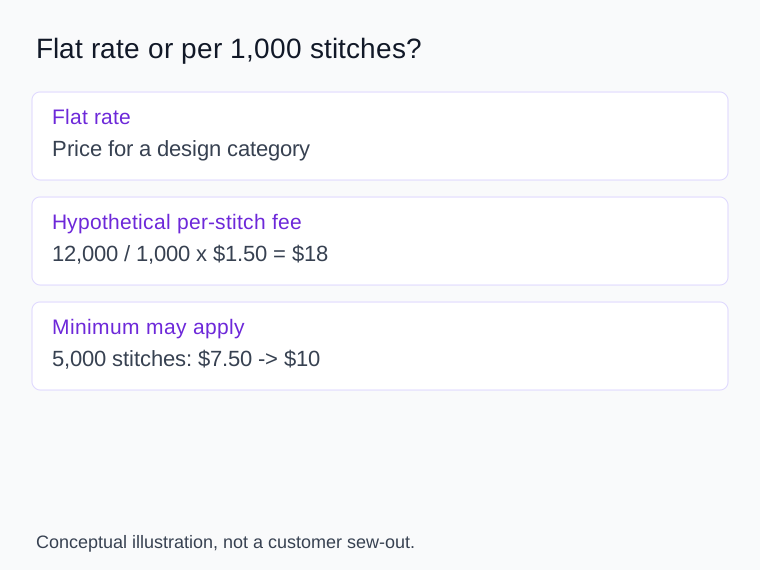
Some digitizing providers calculate their fee according to the number of stitches in the completed design.
The pricing formula is:
Digitizing fee = Stitch count ÷ 1,000 × Rate per 1,000 stitches
A minimum charge may also apply.
For example, imagine a hypothetical provider charging $1.50 per 1,000 stitches with a $10 minimum.
| Design | Stitch Count | Calculated Fee | Final Fee |
|---|---|---|---|
| Simple logo | 5,000 | $7.50 | $10 minimum |
| Medium logo | 12,000 | $18 | $18 |
| Large design | 35,000 | $52.50 | $52.50 |
This is an illustrative calculation, not Aspire Digitizing's pricing policy.
Stitch count is not a perfect measure of digitizing difficulty. Small lettering and complicated artwork can require significant planning even when the finished stitch count is relatively low.
Hourly or Custom-Quote Pricing
Some projects require individual pricing rather than a standard package.
A company may estimate the work based on the time needed, technical complexity, and expected deliverables.
This approach may be appropriate for:
- Highly detailed illustrations
- Portrait-style embroidery
- Designs requiring substantial simplification
- Complex appliqué or specialty stitching
- Multiple production variations
- Extensive correction of an existing design
A custom quote should clearly describe what will be delivered and any additional charges.
Which Pricing Model Offers Better Value?
There is no universally best pricing model.
Flat-rate pricing is useful when you need predictable costs, while per-stitch pricing may suit certain providers and production workflows.
Custom pricing can be more appropriate for unusual or technically demanding designs.
The most useful comparison is not simply the lowest advertised price.
Instead, consider the quality requirements, revisions, file compatibility, communication, and overall cost of getting the design ready for production.
What Factors Affect Embroidery Digitizing Cost?
Several technical factors influence the amount of work required to prepare a machine-ready design.
Understanding them can help you estimate costs and avoid unexpected changes to your quotation.
1. Logo Size and Stitch Count
A larger embroidered design often requires more stitches than a smaller version of similar artwork.
For example, a large jacket-back logo may contain extensive fill-stitch areas, while a small left-chest design may use mostly satin stitches.
However, the relationship between physical size and digitizing cost is not always linear.
A small, complicated logo can require more planning than a large, simple shape.
Tip: Always provide the finished embroidery dimensions when requesting a quote.
2. Design Complexity and Fine Details
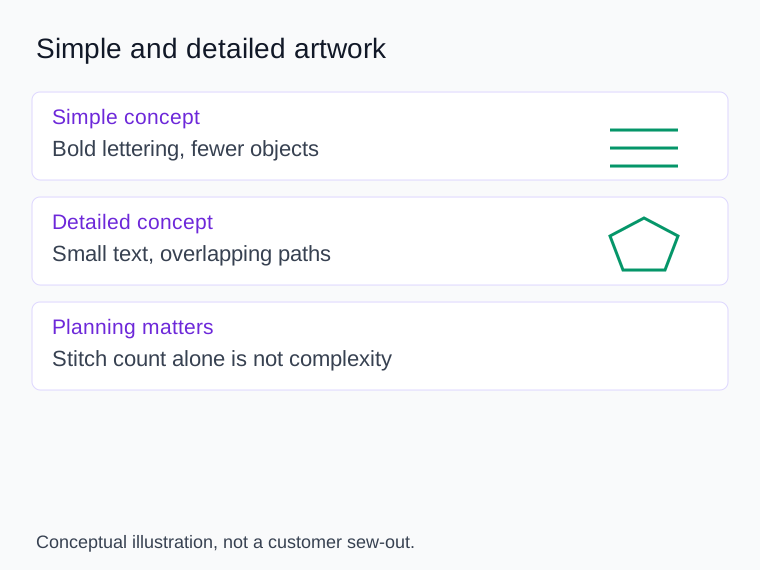
The level of detail in the artwork can significantly affect digitizing work.
A bold two-color company logo may be relatively straightforward.
A detailed emblem with tiny symbols, overlapping shapes, gradients, and numerous borders may require additional preparation or simplification.
Complexity can involve:
- Many small design elements
- Fine outlines
- Overlapping objects
- Intricate lettering
- Frequent color changes
- Difficult stitch sequences
Some visual effects that work well in print may need to be redesigned for embroidery.
3. Small Lettering
Small lettering is one of the most challenging aspects of embroidery digitizing.
Letters that are readable on a computer monitor may become difficult to reproduce cleanly with thread.
The digitizer must consider the stitch type, letter height, spacing, fabric, and machine capabilities.
Extremely small text may require a different font, simplified details, or an increased embroidery size.
That work can affect the final quotation.
4. Garment Type and Fabric
The same design may need different stitch settings for different fabrics.
For example:
- A stable polo shirt has different requirements from a stretchy athletic garment.
- A thick fleece hoodie behaves differently from a lightweight woven shirt.
- A cap introduces a curved embroidery surface and distinct production constraints.
Underlay, density, pull compensation, and stabilization all influence stitching performance.
A design should be prepared with its intended application in mind.
5. Cap vs. Flat Embroidery
Cap embroidery often requires more specialized planning than embroidery on a flat garment.
Designs may need an appropriate sewing direction, sequence, and consideration of the cap's structure.
A left-chest logo that stitches correctly on a polo shirt should not automatically be assumed suitable for a structured cap.
Even when the artwork is identical, a separate cap-oriented file may be necessary.
6. 3D Puff and Specialty Stitching
3D puff embroidery creates raised lettering or shapes using foam underneath the stitches.
The design must be digitized to provide appropriate foam coverage and stitch structure.
Not every logo works equally well for puff embroidery.
Fine lines, sharp internal details, and small letters may need to be modified.
At Aspire Digitizing, the standard rate for 3D puff digitizing is $12, subject to the design's specific requirements.
7. Rush Delivery and Revisions
Urgent deadlines can affect pricing at some providers.
Revisions may also be handled differently depending on the company.
For instance, correcting a technical stitch issue is not necessarily the same task as replacing the entire artwork with a new logo.
Before ordering, ask:
- What is the normal delivery window?
- Is rush delivery available?
- Does rush delivery cost extra?
- What revisions are included?
- Are size conversions priced separately?
Clear expectations are more valuable than assuming all revisions or urgent orders are automatically included.
Embroidery Digitizing Cost by Design Type
Different embroidery applications have different production requirements.
Here is how to think about the costs of common design categories.
Left-Chest Logo Digitizing Cost
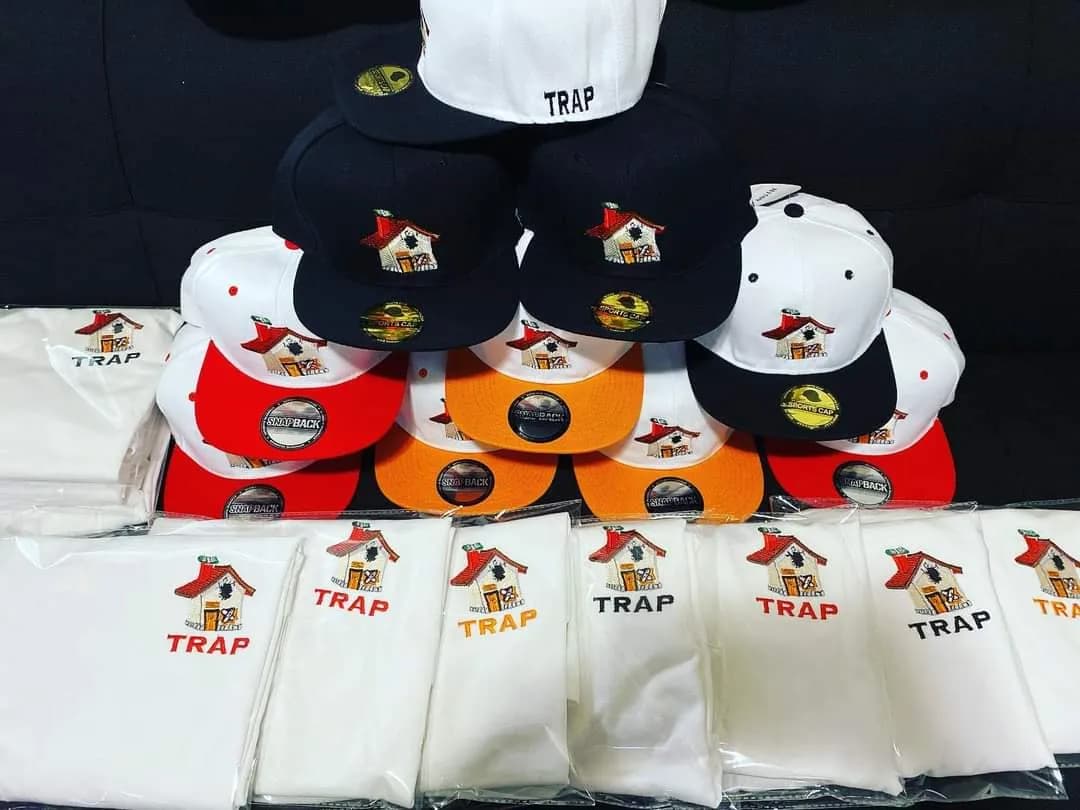
Left-chest embroidery is common for corporate uniforms, polos, shirts, workwear, and branded apparel.
Most left-chest designs are relatively compact, but the complexity can vary significantly.
A simple wordmark may require less preparation than a detailed company badge.
Aspire Digitizing price: $10 for left-chest digitizing.
For best results, send the artwork with the desired width and information about the garment.
Cap and Hat Digitizing Cost
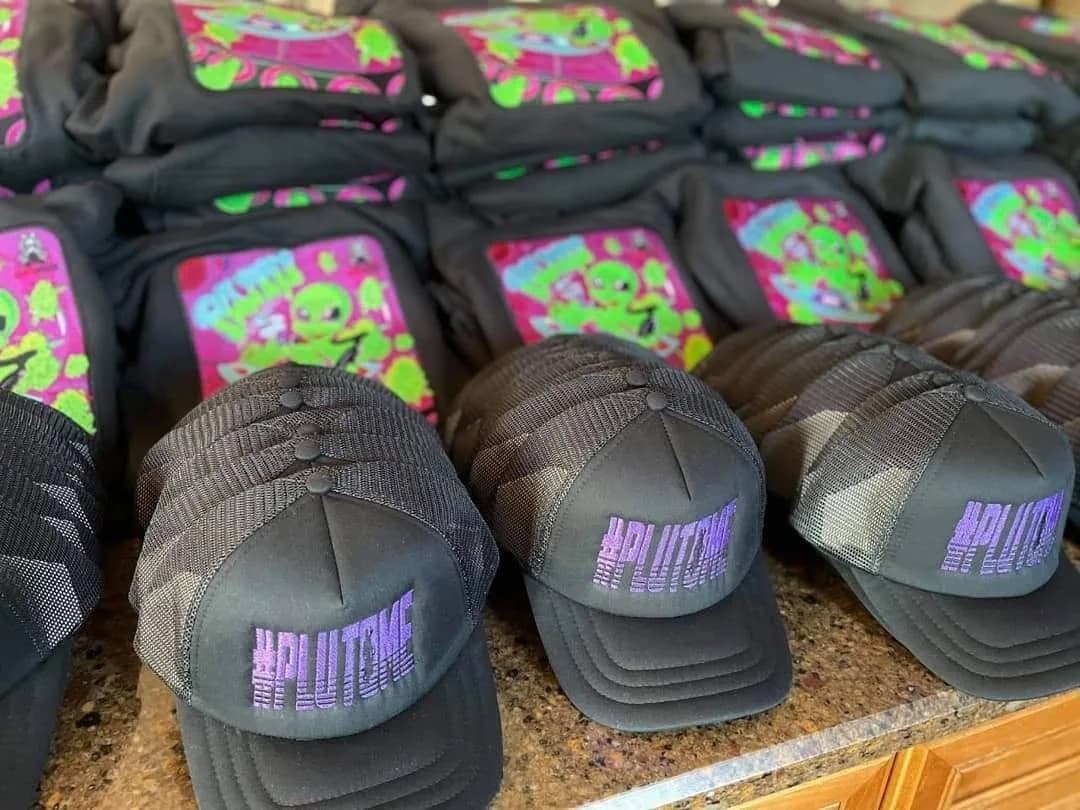
Caps are popular for corporate merchandise, sportswear, uniforms, and promotional products.
Cap embroidery needs attention to the design's proportions, orientation, stitch sequence, and the available embroidery field.
Some designs prepared for flat garments may need adjustments for cap production.
Aspire Digitizing price: $10 for hat digitizing.
If you're ordering both cap and left-chest versions, explain that clearly so the quotation can account for the production requirements.
3D Puff Embroidery Digitizing Cost
3D puff is often used for bold lettering and prominent logos on caps.
Because the raised effect requires a suitable stitch structure, puff digitizing should not be treated as identical to ordinary flat embroidery.
Aspire Digitizing price: $12 for 3D puff digitizing.
Artwork suitability and special technical requirements may affect the final quote.
Designs Under 7 Inches
Some embroidery projects are larger than a typical cap or left-chest logo without being full jacket-back designs.
These may include larger shirt graphics, medium logos, and other custom placements.
Aspire Digitizing price: $15 for designs under 7 inches.
Provide the required dimensions and placement so the team can determine the appropriate file preparation.
The hat/left-chest and 3D puff categories retain their own listed rates; the under-7-inch category is not intended to replace those service-specific prices.
Jacket-Back Digitizing Cost
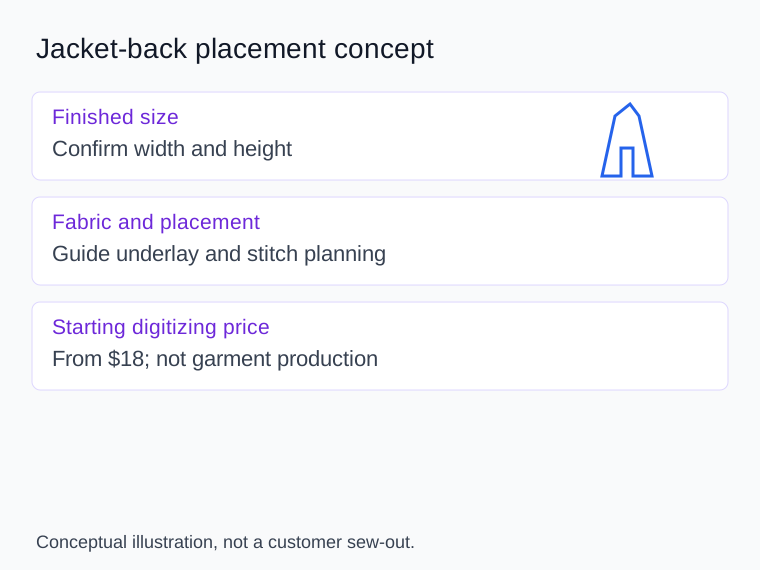
Jacket-back embroidery commonly involves a larger area, more stitches, and potentially more complex artwork.
Depending on the design, the digitizer may need to plan substantial fill areas, outlines, lettering, and sewing sequences.
Aspire Digitizing jacket-back digitizing starts at $18.
This is a starting price, not a fixed rate for every jacket-back design.
Large, highly detailed or technically demanding artwork may require a separate quotation.
Complex Logo and Artwork Digitizing Cost
Complex designs do not fit neatly into a single price range.
Detailed illustrations, small lettering, difficult color transitions, and specialty embroidery may require individual evaluation.
If your logo is complex, send the original artwork and explain where it will be embroidered.
A realistic quote should reflect the preparation work necessary for the intended result.
Aspire Digitizing Pricing: Affordable Embroidery Digitizing Services
At Aspire Digitizing, we aim to offer accessible embroidery digitizing pricing for businesses that need reliable design preparation without unnecessary complexity.
Our standard rates are:
| Service | Aspire Digitizing Price |
|---|---|
| Hat / Left Chest | $10 |
| 3D Puff | $12 |
| Under 7 Inches | $15 |
| Jacket Back | Starting at $18 |
These rates help embroidery shops, apparel brands, and promotional product businesses estimate the digitizing portion of their projects.
The final quotation may depend on artwork complexity, size, placement, and special production requirements.
Example: A Small Embroidery Shop
Imagine an embroidery shop receives three customer requests:
- A business logo for left-chest polos.
- A bold raised logo for 3D puff cap embroidery.
- A larger jacket-back design.
Based on Aspire Digitizing's listed prices:
| Project | Digitizing Price |
|---|---|
| Left-chest logo | $10 |
| 3D puff cap logo | $12 |
| Jacket-back design | From $18 |
| Combined starting estimate | From $40 |
This example assumes three separate designs meeting the relevant starting-price requirements.
It is not an all-inclusive production quote and excludes garment costs, stitching charges, shipping, and any project-specific additions.
For an exact quotation, share your artwork and embroidery requirements through our pricing or quote-request page.
Digitizing Cost vs. Embroidery Stitching Cost
One of the most important distinctions for buyers is the difference between digitizing and the actual embroidery process.
Digitizing creates the machine-ready design file.
Embroidery production uses the machine file to stitch that design onto a physical product.
These are separate services, and their costs should not be confused.
What Does the Digitizing Fee Pay For?
The digitizing fee covers creating or preparing the stitch file for the specified design.
For example, a left-chest logo might have a $10 digitizing charge with Aspire Digitizing.
That $10 does not mean an embroidery company will charge $10 to produce every shirt.
What Does Embroidery Production Cost Include?
An embroidery shop may calculate its production price using several factors:
- Blank garment cost
- Number of garments
- Machine running time
- Stitch count
- Thread and stabilizer
- Hoop setup and handling
- Labor
- Special production requirements
These charges are determined by the embroiderer or garment supplier.
A Practical Cost-Per-Garment Example
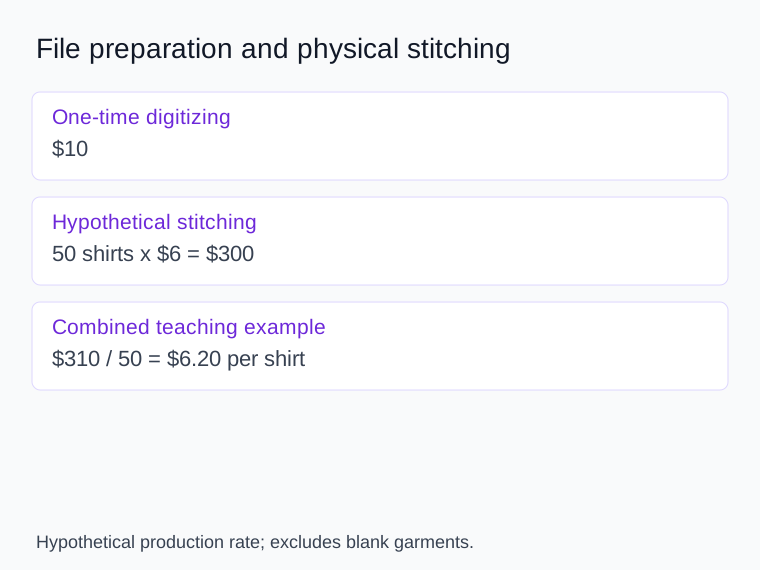
Suppose you own a small clothing brand and order 50 embroidered polo shirts.
Assume the following hypothetical costs:
- One-time digitizing fee: $10
- Embroidery production charge: $6 per shirt
- Quantity: 50 shirts
The embroidery production total would be:
50 × $6 = $300
Adding the one-time digitizing fee:
$300 + $10 = $310
The effective digitizing cost per shirt would be:
$10 ÷ 50 = $0.20
That brings the combined digitizing and embroidery-production cost to $6.20 per shirt, excluding the blank garments and any additional charges.
The $6 production rate is only a hypothetical teaching example—not a published Aspire Digitizing embroidery-production price.
If the same approved digitized file can be reused for a future order, the original digitizing fee may not need to be paid again.
This is why the effective digitizing cost per garment becomes smaller as the number of garments using the same file increases.
Are Cheap Embroidery Digitizing Services Worth It?
Affordable digitizing can be a good choice, especially for simple logos and routine production work.
However, the lowest price is not always the lowest total cost.
A file that requires repeated corrections or produces poor sew-outs may result in extra labor, delays, or wasted materials.
Price Alone Does Not Determine Quality
A simple design may be digitized efficiently at a low rate.
Meanwhile, a highly detailed logo may require more time and technical planning.
A higher price does not automatically guarantee better results, and a lower price does not automatically indicate poor work.
The important question is whether the file is prepared correctly for the required application.
What to Look For in a Digitized File
A well-prepared design should consider:
- Appropriate stitch types
- Suitable stitch density
- Underlay where needed
- Pull compensation
- Logical sewing sequence
- Manageable jumps and trims
- Intended garment and placement
- Machine compatibility
A computer preview can help identify some issues, but actual sew-out testing is important when validating production performance.
The Hidden Cost of Production Errors
Suppose an embroidery shop saves $5 on digitizing but later spends extra machine time correcting the design.
If the problem also causes wasted garments or delayed delivery, the initial saving may disappear.
This is a hypothetical scenario illustrating total production cost—not evidence that low-cost digitizing providers routinely create faulty files.
Recommendation: Compare the provider's communication, technical process, correction terms, and suitability for your production workflow alongside the quoted price.
Common Hidden Fees to Check Before Ordering
Not every digitizing company structures its pricing the same way.
Some offer bundled services, while others charge separately for additional tasks.
Before placing an order, clarify whether your quotation covers the following.
Additional Sizes
A substantially different embroidery size may require more than simple proportional scaling.
Very small lettering or large fill areas may need digitizing adjustments.
Ask whether separate size versions are included or charged individually.
Cap and Flat Versions
A cap-oriented file and a flat-garment file may need different settings or stitch sequences.
Do not assume that both versions are included in a single quote.
Machine File Formats
Common embroidery formats include DST, PES, EXP, JEF, and VP3.
Ask which file formats will be delivered and whether additional exports cost extra.
For a practical explanation of machine compatibility, read DST vs PES vs EXP: Understanding Embroidery File Formats.
Revisions and Corrections
Find out whether technical stitch corrections are included.
Also ask how the provider handles major artwork changes or redesign requests.
Editable Source Files
An EMB file or another native embroidery file may provide greater editing flexibility than an exported machine file.
Not every provider supplies editable source files as part of a standard package.
If you need them, confirm availability and terms before ordering.
Rush Service
If you need a file urgently, confirm the delivery expectation and any rush fee before production starts.
Artwork Cleanup
Low-resolution, blurry, or highly complex artwork may require cleanup or simplification before digitizing.
Ask whether substantial artwork preparation is included in your quote.
These are general questions to ask any provider, not a claim that Aspire Digitizing charges every fee listed above.
How to Reduce Your Embroidery Digitizing Costs
You don't necessarily need to choose the cheapest provider to keep your embroidery preparation costs under control.
Good planning can reduce avoidable rework and help you get more value from each digitized file.
1. Submit Clear Artwork
Provide the clearest available version of your logo.
Vector artwork can be particularly helpful, but a high-quality raster image may also be suitable.
Avoid blurry screenshots or compressed images when better originals are available.
2. Confirm the Final Embroidery Size
Specify your target width or height before digitizing begins.
For example, tell the provider whether you need a 3.5-inch-wide left-chest logo or a 10-inch-wide back design.
That reduces uncertainty about the intended stitch structure.
3. Identify the Fabric and Placement
Mention whether the artwork will go on a cap, polo shirt, hoodie, jacket, or patch.
Different materials and placements can require different embroidery settings.
4. Know Your Machine Format
Check the machine manufacturer's required file format.
Requesting the correct format upfront can prevent unnecessary conversion work.
5. Keep an Organized File Library
Store your approved digitized files with descriptive names.
Include useful details such as:
- Customer or brand name
- Design identifier
- Finished embroidery size
- Intended placement
- Machine format
- Version or revision number
This helps prevent ordering the same design again unnecessarily.
6. Reuse Suitable Approved Designs
An existing digitized file may be reusable when the size, fabric, placement, and machine requirements remain compatible.
Do not reuse a file blindly for a substantially different application.
7. Discuss Repeat-Order Requirements
If your business sends designs regularly, explain your expected volume and turnaround needs.
Ask whether the provider offers any relevant account or volume arrangements.
Do not assume a volume discount is available unless it has been specifically confirmed.
How to Choose the Right Embroidery Digitizing Service
Selecting a digitizing company is an operational decision, especially if you depend on embroidery production for customer orders.
A reliable provider should be able to understand your artwork requirements and communicate what is included in the quoted service.
Use this checklist when comparing providers.
| What to Check | Why It Matters |
|---|---|
| Transparent pricing | Helps you plan costs |
| Embroidery experience | Supports suitable stitch planning |
| Machine format support | Helps avoid compatibility issues |
| Communication | Reduces misunderstandings |
| Revision terms | Clarifies how corrections are handled |
| Turnaround expectations | Helps protect production schedules |
| Artwork preparation | Establishes whether simplification is needed |
| Production feedback | Helps resolve actual sew-out issues |
Ask Questions Before Your First Order
Before submitting a design, ask:
- What is the digitizing price for my exact size and placement?
- Which machine formats can you provide?
- What revisions are included?
- Do you need specific garment or fabric details?
- Will I receive an editable source file if requested?
- What is the expected turnaround?
- How should I report a sew-out problem?
Clear answers can be more valuable than a small difference between competing quotes.
Frequently Asked Questions
How Much Does It Cost to Digitize a Logo for Embroidery?
The cost varies according to size, complexity, placement, and provider. Publicly advertised examples include small-logo prices around $10–$20, while more complex or larger designs may cost more. Aspire Digitizing charges $10 for standard hat or left-chest digitizing.
How Much Does a Left-Chest Logo Cost to Digitize?
Left-chest digitizing prices depend on the provider and artwork requirements. Aspire Digitizing's standard left-chest digitizing price is $10.
What Is the Cost of Digitizing a Hat Logo?
Hat digitizing prices vary according to the logo and production requirements. Aspire Digitizing's listed rate for standard hat digitizing is $10.
Is 3D Puff Digitizing More Expensive?
It can be, because puff embroidery requires specialized stitch planning and foam coverage. Pricing depends on the provider. Aspire Digitizing's standard 3D puff digitizing rate is $12.
How Much Does Jacket-Back Digitizing Cost?
Jacket-back pricing depends on design size and complexity. Aspire Digitizing's jacket-back digitizing starts at $18. Other providers may advertise considerably higher rates for large designs.
Is Embroidery Digitizing a One-Time Fee?
It is often a one-time fee for preparing a particular design version. You may be able to reuse the file for later embroidery orders. Different dimensions, fabric, placements, or design changes may require additional work.
Do Digitizers Charge Per Stitch?
Some do. Others charge flat rates based on design category, size, or complexity. Per-stitch pricing should not be confused with per-garment embroidery production charges.
Can I Get Embroidery Digitizing for Under $15?
Yes. Aspire Digitizing lists standard hat and left-chest digitizing at $10 and 3D puff digitizing at $12. Final pricing depends on the design's requirements.
Does Converting PNG to DST Cost Money?
Creating a proper DST embroidery file from PNG artwork generally involves digitizing work, which may carry a service fee. Merely renaming a PNG file to DST does not produce valid embroidery instructions.
What Is the Difference Between Digitizing and Embroidery Cost?
Digitizing is the process of preparing an embroidery machine file. Embroidery production is the physical stitching of that design onto a garment or other item. These are usually separate charges.
Can One Embroidery File Work for Different Garment Sizes?
Sometimes a file can be reused for compatible applications, but major size changes may require stitch adjustments or a separately digitized version. Large resizing changes can affect density, lettering, and stitch quality.
Do I Need to Pay Extra for PES, DST, or EXP Formats?
That depends on your provider's service terms. Some digitizing companies include multiple machine formats, while others may charge separately for additional exports. Confirm the included file formats before ordering.
Final Thoughts: Understanding Embroidery Digitizing Prices
The cost of embroidery digitizing depends on more than the number of stitches in a design.
Artwork complexity, finished dimensions, fabric, placement, machine compatibility, and service terms all affect what you may pay.
For many buyers, the most practical approach is to start with a clear price quotation and verify what it includes.
At Aspire Digitizing, our standard pricing begins at $10 for hat or left-chest logos, with 3D puff at $12, designs under 7 inches at $15, and jacket-back digitizing starting at $18.
A properly prepared embroidery file can be reused for suitable repeat orders, helping spread the original digitizing fee across more garments.
Ultimately, value comes from balancing price, stitch quality, compatibility, communication, and dependable production preparation.
Request an Embroidery Digitizing Quote From Aspire Digitizing
Need a logo digitized for caps, uniforms, polo shirts, jackets, or another embroidery project?
Aspire Digitizing provides embroidery digitizing services for embroidery businesses, apparel brands, promotional product companies, and custom merchandise suppliers.
To receive an accurate quote, share your:
- Original artwork or logo
- Required embroidery dimensions
- Garment type and placement
- Embroidery machine format
- Any deadline or special instructions
Our team can review your requirements and confirm the applicable digitizing quotation.
Request an Embroidery Digitizing Quote
Get your artwork prepared for your embroidery production workflow.